Recraft V4: image generation with design taste
Recraft V4 is Recraft’s latest image generation model, rebuilt from the ground up. The big idea behind it is what the Recraft team calls “design taste” — the model makes visual decisions about composition, lighting, and color that feel intentional rather than generic. Images come out looking art-directed, even from simple prompts.
V4 comes in four versions — two raster, two vector:
| Model | Output | Resolution | Speed | Price |
|---|---|---|---|---|
| Recraft V4 | Raster (WebP) | ~1024px | ~10s | $0.04/image |
| Recraft V4 Pro | Raster (WebP) | ~2048px | ~28s | $0.25/image |
| Recraft V4 SVG | Vector (SVG) | Standard | ~15s | $0.08/image |
| Recraft V4 Pro SVG | Vector (SVG) | High-res | ~30s | $0.30/image |
All four share the same design taste and prompt accuracy. The differences are output format, resolution, and speed.
Some examples
These prompts are designed to push V4 into territory where most image models fall flat — complex typography layouts, precise material rendering, extreme detail at macro scale, structured vector assets, and stylized illustration with character.
Typography and editorial design
V4 treats text as a first-class element of composition. This prompt asks for a cinematic editorial poster with specific typographic hierarchy — “INTERVAL” placed vertically, a subtitle with a thin cyan rule, numbered sections. V4 nails the layout, integrating the typography into the mood of the image rather than stamping it on top:
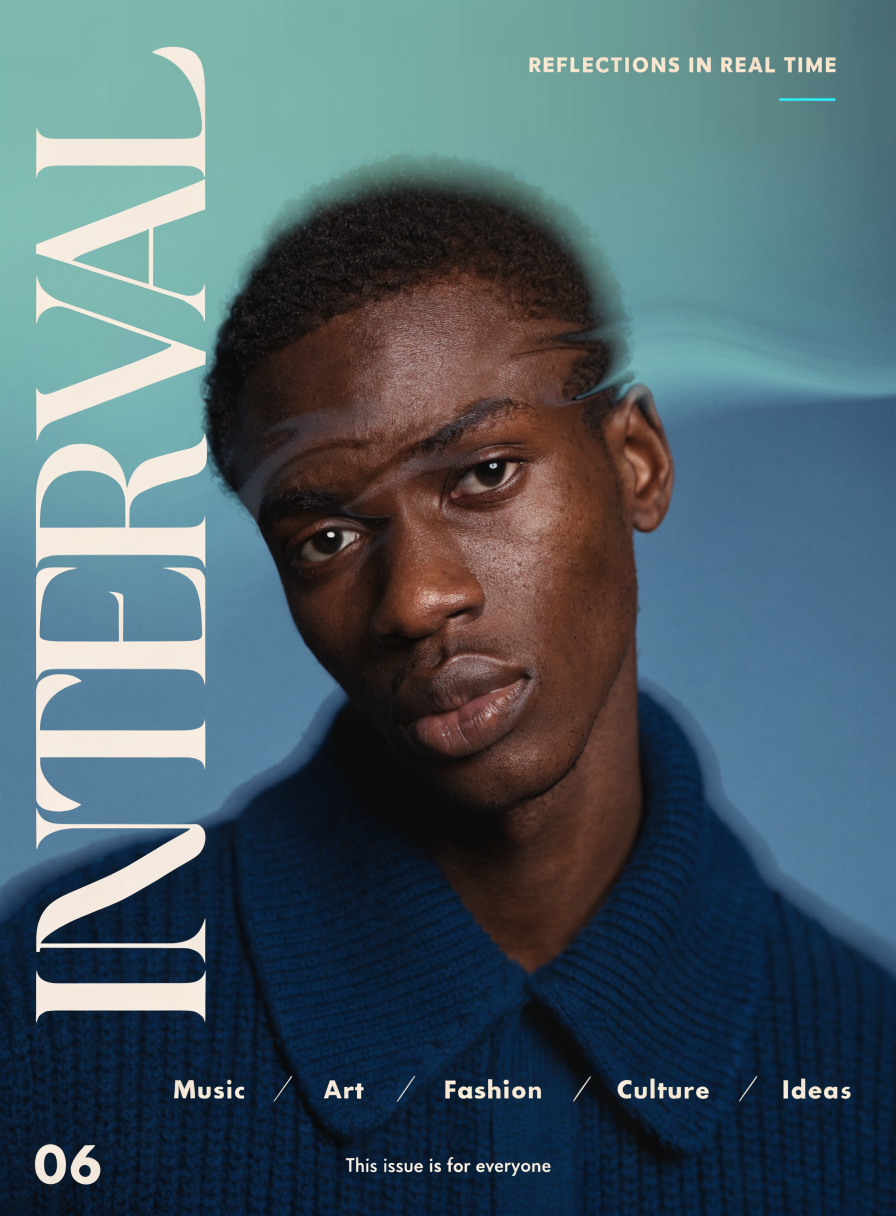
“Minimal cinematic editorial poster. Chest-up portrait in dark coat, sharp face with soft halo diffusion, shallow depth, introspective gaze. Petrol-teal to slate-blue gradient background. Subtle translucent refraction across face. Warm off-white big typography: ‘INTERVAL’ vertical left, subtitle top-right with thin cyan line, section row lower third. ‘06’ bottom-left, footer centered. Clean hierarchy, large negative space, ultra high resolution.”
Commercial product photography
Product shots need precise material rendering and lighting control. This prompt specifies brushed steel, matte aluminum, micro-reflections from an engraved monogram, glossy highlights, and motion light streaks — all on a vibrant gradient background. V4 handles the material physics and the playful commercial energy together:

“A playful commercial still life of a sleek metallic minimalist perfume bottle. Brushed steel or matte aluminum finish, clean geometric silhouette, cap casually placed beside the bottle. Engraved on the front: subtle ‘ION’ monogram, minimal and refined, precisely etched into the metal surface. The engraving catches the light softly, creating elegant micro-reflections. Set on a smooth pastel surface. Bright vibrant gradient background (peach to coral or sky blue to lilac). Glossy reflections, soft diffused studio lighting, crisp highlights and gentle shadows. Add subtle motion light streaks or color reflections for energy. Modern commercial fragrance aesthetic — fun, stylish, energetic, premium yet approachable.”
Extreme macro detail
This is a stress test for texture and light rendering. The prompt asks for iridescent snake scales with a neon-green-to-violet color shift, glossy highlights revealing micro-textures under dramatic side light, and razor-sharp focus with shallow depth of field. V4 resolves each overlapping scale individually:

“Extreme macro of snake scales filling the frame. Iridescent surface shifting from vibrant neon green to rich violet, smooth luminous transition across overlapping scales. Glossy highlights under dramatic side light reveal fine micro-textures. High contrast, shallow depth of field, razor-sharp focus. Dark minimal background, cinematic macro photography, ultra high resolution.”
Structured vector icon sets (SVG)
Icon sets require consistency — uniform stroke weight, cohesive style, aligned geometry across multiple distinct shapes. This prompt asks Recraft V4 SVG for six icons with thick black outlines and neon green accents, each depicting a different abstract concept. The output is a real .svg file you can open in Figma or Illustrator and edit path by path:
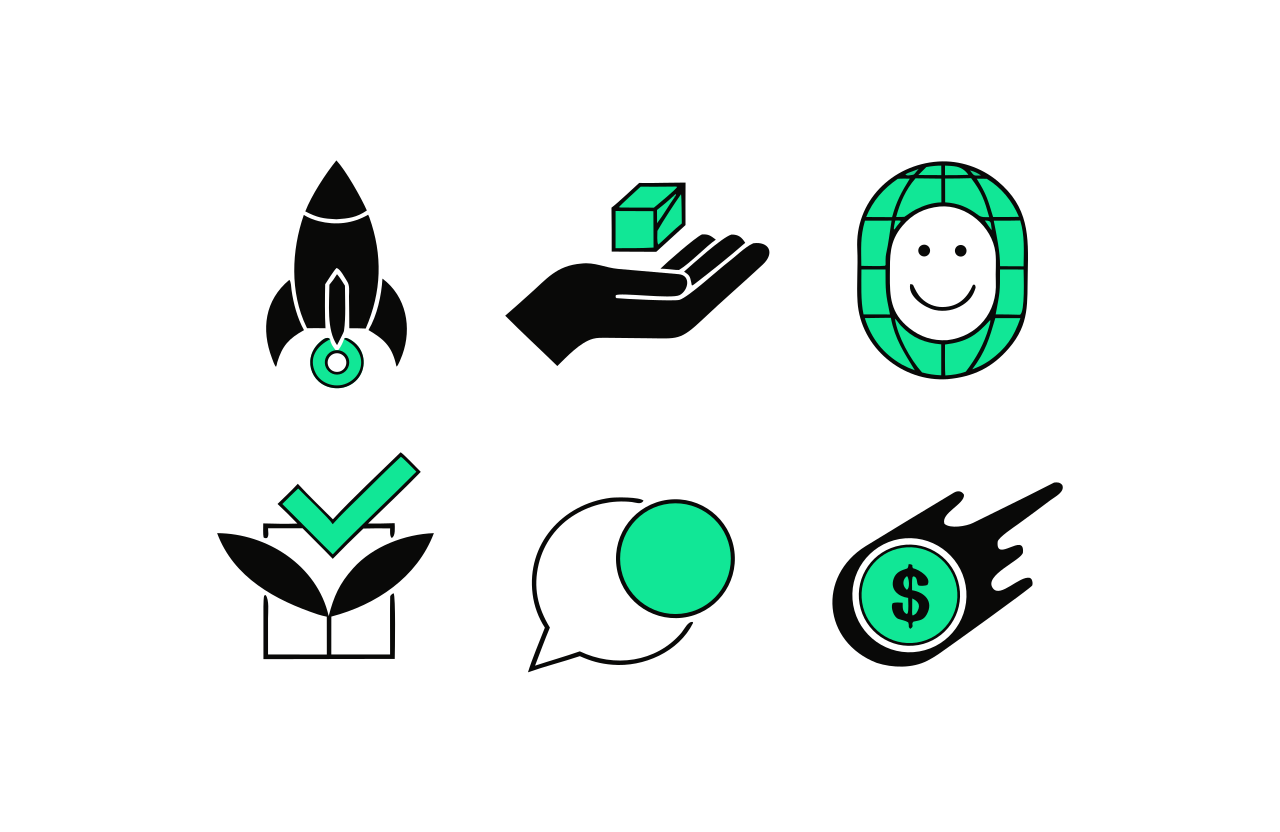
“Create a set of 6 clean vector icons in a bold minimal style: thick black outlines, flat white background, bright neon green accents only, no gradients, no shadows. Slightly playful abstract shapes, modern startup vibe. Icons: rocket launch button, hand holding a tiny cube, smiling AI face with grid overlay, checkbox growing like a plant, chat bubble with a coin, a coin with a dollar sign rolling like a comet.”
Stylized illustration
V4 can also generate illustrations with real artistic character — not just photorealism. This prompt asks for distorted proportions, a distinct style, and a vibrant color palette. The model makes its own design choices about how to interpret “levitating” and “random objects,” producing something that feels hand-drawn rather than generated:

“A nice modern vector illustration of a man levitating with a number of various random objects around him. Distinct style, distorted proportions and unique vibrant color palette.”
Native SVG generation
This is the really interesting part. Recraft is the only image generation model that produces native vector output — actual SVG files with real paths, structured layers, and clean geometry. Not traced rasters. Not bitmaps wrapped in an SVG container. Real, editable vector graphics.
The output opens directly in Illustrator, Figma, or Sketch. You can edit paths, recolor elements, scale to any size. No tracing, cleanup, or conversion steps.
The icon set example above demonstrates this — those six icons are a single .svg file with clean vector paths. You can drop it directly into a design tool or onto a webpage. This is useful for brand assets, icon sets, illustrations, logos, and anything that needs to scale cleanly or be edited after generation.
What’s new in V4
Most image generation models are tuned for broad general preference. V4 takes a different approach: it was developed in collaboration with designers and tuned specifically around design aesthetics and professional expectations.
In practice, this shows up in a few ways:
Art-directed composition. V4 makes choices about how elements are arranged, how colors relate to each other, and where the eye moves through the frame. When you compare its output side-by-side with other models, V4’s images tend to feel more like they were art-directed and less like stock photography.
Strong prompt accuracy. Whether your prompt is a few words or a detailed paragraph (the model accepts up to 10,000 characters), V4 follows it closely while keeping the overall image coherent.
Integrated text rendering. V4 treats typography as a structural part of the image, not an afterthought. Text interacts with the scene — bridging visual elements, responding to spatial context, and fitting naturally into the design. This is a standout feature for posters, packaging, editorial layouts, and any work where text is part of the composition.
Native vector output. The SVG models produce actual editable vector files with clean paths and structured layers. This is unique to Recraft — no other image generation model does this.
Running the models
Here’s a raster example using Replicate’s JavaScript client:
import Replicate from "replicate";
const replicate = new Replicate();

const output = await replicate.run("recraft-ai/recraft-v4", {
  input: {
    prompt: "Extreme macro of snake scales filling the frame. Iridescent surface shifting from vibrant neon green to rich violet, smooth luminous transition across overlapping scales. Glossy highlights under dramatic side light reveal fine micro-textures. High contrast, shallow depth of field, razor-sharp focus. Dark minimal background, cinematic macro photography, ultra high resolution.",
    aspect_ratio: "4:3",
  },
});
console.log(output);
// => "https://replicate.delivery/...webp"
And here’s the SVG model — same API, but the output is an SVG file:
const svg = await replicate.run("recraft-ai/recraft-v4-svg", {
  input: {
    prompt: "Create a set of 6 clean vector icons in a bold minimal style: thick black outlines, flat white background, bright neon green accents only, no gradients, no shadows. Slightly playful abstract shapes, modern startup vibe. Icons: rocket launch button, hand holding a tiny cube, smiling AI face with grid overlay, checkbox growing like a plant, chat bubble with a coin, a coin with a dollar sign rolling like a comet.",
    aspect_ratio: "3:2",
  },
});
console.log(svg);
// => "https://replicate.delivery/...svg"
In Python:
import replicate

output = replicate.run(
    "recraft-ai/recraft-v4",
    input={
        "prompt": "A nice modern vector illustration of a man levitating with a number of various random objects around him. Distinct style, distorted proportions and unique vibrant color palette.",
        "aspect_ratio": "1:1",
    },
)
print(output)
# => "https://replicate.delivery/...webp"
All four models accept the same three inputs:
prompt— your text description (up to 10,000 characters)aspect_ratio— common ratios like1:1,4:3,16:9,9:16, and moresize— explicit dimensions like1024x1024,1536x768, etc. (ignored if aspect ratio is set)
Which model should you use?
- V4 — Fast raster output for web, social media, concept exploration, and rapid iteration.
- V4 Pro — High-res raster for print production, large-format displays, and detailed work.
- V4 SVG — Vector output for icons, logos, brand assets, illustrations, and anything that needs to scale or be edited.
- V4 Pro SVG — High-detail vector for large-format print, detailed illustrations, and design system components.
Licensing
Images generated with Recraft V4 on Replicate can be used commercially. See Recraft’s terms for details.
Give them a try: Recraft V4, Recraft V4 Pro, Recraft V4 SVG, and Recraft V4 Pro SVG.